
 By sl lives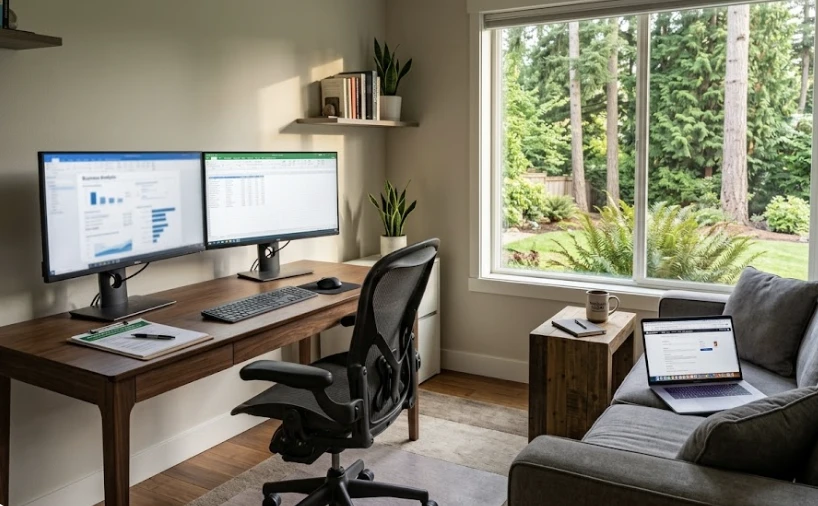
What Kirkland WA Remote Workers Learn About Home Office Furniture After Year Two
Kirkland’s identity shifted quietly over the past few years. A city that had already established itself as a bedroom community for Microsoft’s Redmond campus became something more during the remote work expansion — a primary work location for thousands of people who had been commuting east across Lake Washington and then, suddenly, weren’t. By 2024, King County had one of the highest sustained remote work rates among major US metropolitan areas, with Puget Sound Regional Council data suggesting roughly 42 percent of employed residents in the eastern King County corridor were working from home at least three days per week. Kirkland, with its mix of tech professionals, small business owners, and freelancers who’d relocated specifically for the lifestyle, landed at the higher end of that range.
The practical consequence of that shift was that home furniture — particularly upholstered seating — began carrying a workload it was never designed for. The couch that absorbed weekend movies and occasional evenings became the daily secondary workstation, the video call background, the lunch spot, the decompression zone between meetings. A chair that once saw a few hours of use per week became the primary seating for eight or nine hours a day, five days a week. Two years in, the upholstered furniture in Kirkland remote worker households shows it — and most households didn’t see it coming because the deterioration happens gradually.
What Daily Use Actually Does to Upholstered Furniture
The wear pattern on furniture used for daily work is different from casual residential use in ways that aren’t obvious until they’re visible. Body oils from extended daily contact penetrate upholstery fabric at a rate roughly proportional to contact duration. A couch used for two hours on a weekend evening and a couch used as a daily workstation for eight hours accumulate body oil residue at dramatically different rates. Over two years of consistent remote work use, the cumulative penetration in microfiber or fabric upholstery reaches a threshold where surface cleaning — vacuuming, spot treatment — stops being effective at addressing the odor and discoloration that develops below the visible layer.
Food contact compounds this. Remote workers eat at their workstations at a significantly higher rate than office workers, partly because there’s no cafeteria to walk to and partly because leaving the workspace costs more friction when the workspace is at home. In an eight-hour remote work day, furniture that serves as primary or secondary seating absorbs coffee, lunch residues, snacks, and whatever accompanies the 3pm energy correction. These residues are largely invisible as they accumulate — they darken fabric gradually, attract particulates, and eventually contribute to a baseline odor that becomes noticeable when the room has been closed for a few hours.
The third variable is cushion compression. Extended daily use compresses the foam fill in seat cushions at a rate that produces visible sag within 18 to 24 months for furniture not rated for commercial-grade daily use. Most residential sofas are designed around 2–4 hours of daily use. Running them at 8–10 hours accelerates the compression timeline significantly. Professional hot water extraction can’t reverse foam compression, but it restores surface fabric texture and removes accumulated contamination in ways that make the furniture feel and perform meaningfully better — often the difference between furniture that feels finished and furniture that reads as actively usable.
The Maintenance Gap That Remote Work Creates
The furniture care assumption most Kirkland households carry into remote work life is a residential one: clean when it looks dirty. That works adequately for furniture on a casual residential schedule. It doesn’t work for furniture running on a commercial-use schedule. Upholstery absorbs and holds contamination below the visible surface — oils, organic residues, particulates — at a pace that outstrips what casual inspection catches. The furniture can look acceptable long after it’s functioning as a contamination reservoir that affects indoor air quality and generates low-level odors that residents stop noticing because they’re always present.
Professional upholstery cleaners working across the Kirkland and Bellevue market see this pattern consistently: remote workers bringing in furniture for the first time after two or three years of daily use are routinely surprised by the extraction water color. Fabric that looked “a bit worn but fine” yields extraction water ranging from beige-brown to dark brown depending on fabric type and intensity of use. What the cleaning reveals — and then addresses — is a contamination load that was invisible but present the entire time, affecting the environment of the space where the person was spending the majority of their working day.
The Business Case: Cleaning Versus Replacing Kirkland Home Office Furniture
The furniture replacement cycle in Kirkland has accelerated alongside the remote work shift. Home furnishing retailers in the Seattle metro reported elevated residential furniture turnover in 2023 and 2024, driven partly by households discovering that furniture sized for casual use wasn’t holding up under remote work conditions. The replacement impulse is understandable, but it’s frequently premature. Furniture that shows fabric discoloration, some compression, and a baseline odor after two years of remote work use is typically a cleaning candidate — not a replacement candidate — if the frame and structural elements are still intact.
A professional couch cleaning service Kirkland WA runs $150 to $350 for a standard sofa depending on fabric type, condition, and size, with complete home office sets — sofa, loveseat, two chairs — typically landing between $300 and $600. Against furniture replacement costs for comparable quality, which run $1,500 to $4,000 for a full living room or home office set, the maintenance economics are straightforward. A set that can be restored to near-original usability and appearance with a $400 cleaning isn’t a replacement candidate, even when it looks like one from across the room.
The scheduling consideration for remote workers is real but manageable. Professional extraction requires a dry time of two to six hours depending on fabric and method. Most Kirkland cleaning services work on the assumption that a morning appointment allows afternoon return to use. The operational disruption for a remote worker — a few hours at one of Kirkland’s coffee shops or the library downtown — is predictable and plannable, unlike the disruption of furniture shopping, delivery coordination, and the two to four weeks of living with a diminished home office setup while new furniture is on order.
What Professional Extraction Covers That DIY Methods Don’t Reach
The DIY options available to Kirkland remote workers — upholstery shampoo machines, rental carpet cleaners with upholstery attachments, spray-and-blot products — are effective at surface soil removal and fresh stain treatment. They’re not effective at substrate-level contamination removal, which is what makes a meaningful difference in furniture that’s been in heavy daily use for two or more years. The operational gap is water temperature and extraction pressure.
Professional truck-mounted extraction operates at water temperatures between 200°F and 210°F, with extraction vacuum pressure substantially higher than any consumer equipment generates. At those temperatures, body oil residues that have polymerized into fiber structure are emulsified and removed, organic food residues that have bonded to fabric fibers are released, and the fiber structure is flushed rather than surface-cleaned. The difference on furniture with two years of remote work use isn’t subtle. The extraction water tells the story in the first few passes — and the furniture that comes out of the process smells different, feels different in texture, and performs differently as a workspace environment.
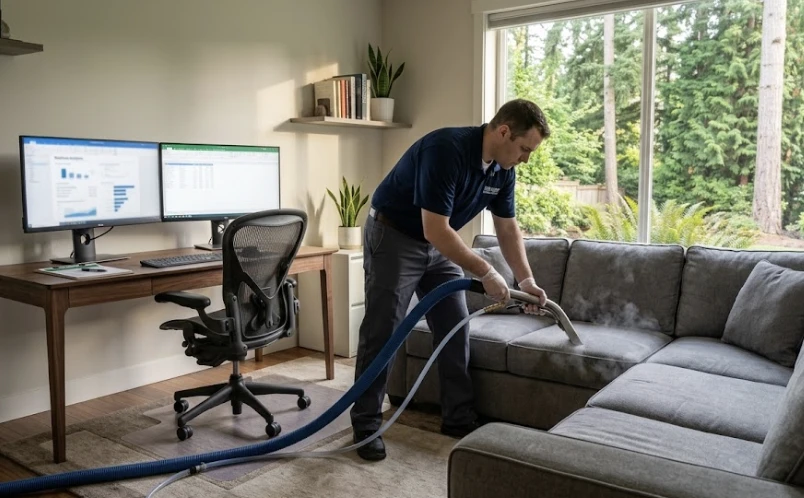
Kirkland residents who’ve been through the process consistently describe the result as feeling like different furniture — not always visually transformed, but different in the environmental quality of the room. For a home where the primary earner is spending eight or more hours per day in upholstered seating, that quality difference has practical consequences for concentration, comfort, and the sustainable economics of a remote work setup that the original furniture purchase didn’t account for. The investment that made sense in 2021 can keep making sense in 2026, if it’s maintained on the schedule that the actual use pattern requires.