
 By sl lives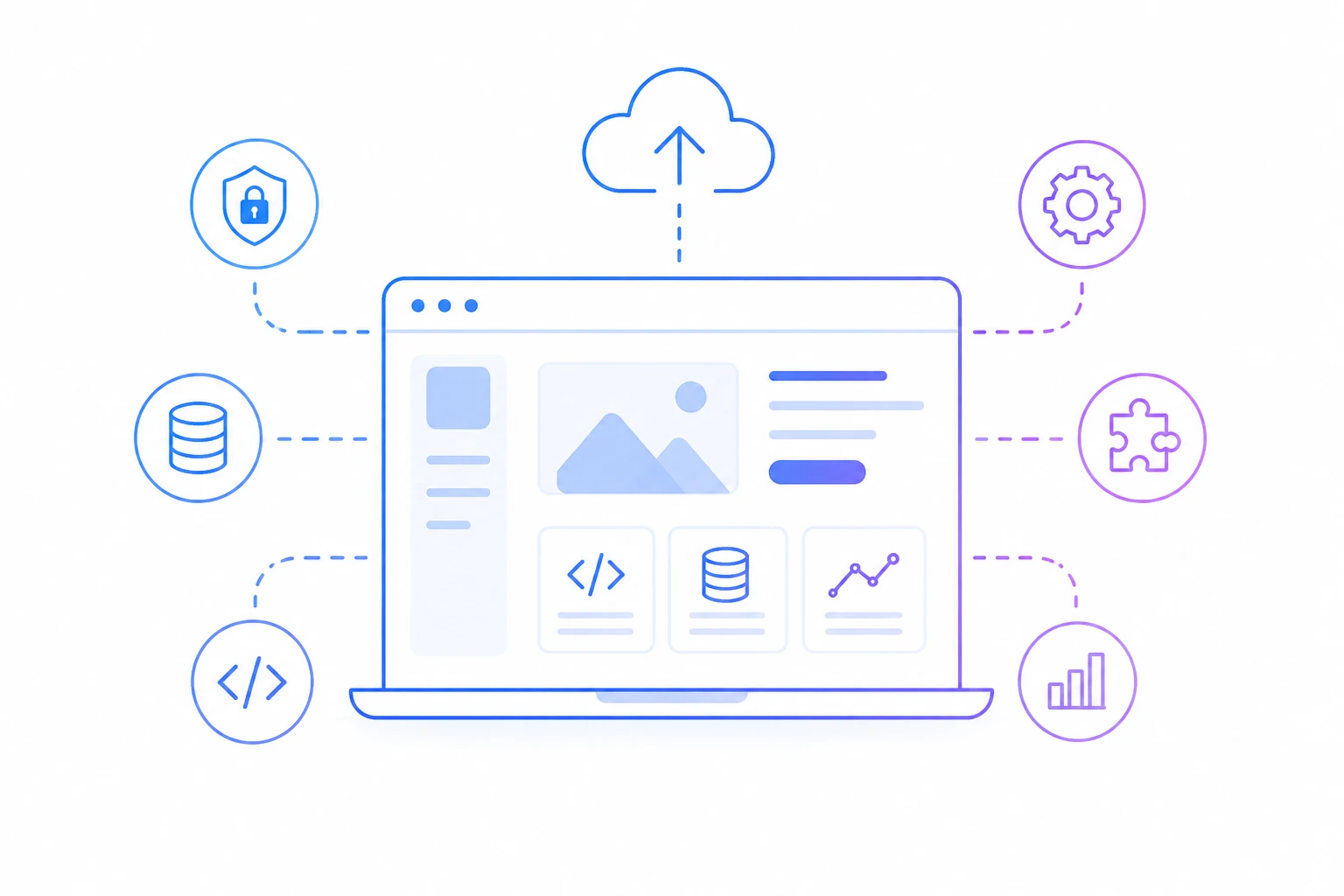
Modern web development is not only about building new products. It also includes legacy application modernization with AI : upgrading outdated PHP systems, moving critical functionality to Laravel, introducing modern APIs and interfaces, improving security and performance, and preparing existing software for AI-powered search, automation, and document processing.
A modern web product may look simple, but behind it are APIs, databases, integrations, security, cloud infrastructure, testing, monitoring, and often AI. Modern web development is no longer just design and coding. It is the process of turning a business problem into a reliable digital system.
At Kavita Systems, we cover the full cycle—from discovery and UX/UI design to development, AI integration, modernization, and ongoing support.
A website is not always just a website
Traditional websites were mainly created to publish information. Modern web products manage accounts, process payments, synchronize inventory, automate documents, connect departments, and support employees.
A browser-based product may be a portal, SaaS platform, internal system, B2B application, marketplace, booking platform, or a modern interface connected to older PHP software.
A company may ask for a dashboard, while the real requirement is a system that collects data from several platforms, applies business rules, verifies permissions, stores documents, and presents the right information to each user.
Modern web development therefore begins before the first component is coded.
Product discovery comes before technology
One of the most common software mistakes is choosing technology before understanding the problem.
The first conversation should not focus on React, Vue, Laravel, Symfony, or Node.js. It should focus on what needs to improve after launch.
Who will use the system? How does the process work today? Where do delays and errors occur? Which platforms already contain the data? What measurable result does the business expect?
These questions often change the project. A client may request an AI assistant when employees first need better documentation and search. A company may want a dashboard when the real problem is inconsistent data copied manually between systems.
Discovery defines the smallest useful product and reveals integration risks, undocumented rules, data problems, and assumptions that should be tested early.
Good discovery prevents the team from building the wrong product quickly.
UX/UI design turns business logic into a usable product
UX design transforms business rules into clear journeys, screens, actions, and feedback.
Users need to understand what to do next, why information is required, whether an action was successful, and what happens when something goes wrong. A technically correct product can still fail if employees avoid using it or customers cannot complete an important task.
UX work may include research, process mapping, wireframes, prototypes, accessibility planning, and usability testing.
UI design creates the product’s visual language. It must also be consistent, responsive, accessible, and practical to implement.
As the product grows, its interface usually develops into a design system. Designers and developers work with the same component logic and behavior. New screens can be created faster, while users benefit from predictable interactions.
Frontend and backend engineering
Frontend development transforms design into a working application, including routing, APIs, forms, authentication, accessibility, performance, and testing.
Frameworks such as Vue, Nuxt, React, and Next.js help teams organize larger applications. However, a popular framework does not automatically create a maintainable product.
Components need clear responsibilities and predictable data flow. TypeScript is often used because explicit contracts can detect errors earlier and make large applications safer to modify.
Frontend engineers also need to understand the business rules behind the interface. A pricing field, approval button, or order status may look simple while representing complex logic in the backend.
The backend applies business rules, communicates with databases and external services, and controls access.
The most important backend decisions concern responsibility and failure.
Which system owns customer information? What happens if a payment succeeds but the order cannot be created? Can a request run twice without creating duplicates? How are failed jobs retried? Which actions need an audit history?
Strong architecture makes these decisions explicit instead of hiding them across unrelated files.
Data and integrations connect software with the real business
Most serious web products depend on existing systems. A company may already use CRM, ERP, accounting, payment, warehouse, support, analytics, and document platforms.
The new application often needs to connect them.
A customer submits an order. Pricing is verified. The order is sent to the ERP. Inventory is reserved. Payment is processed. The warehouse receives a task. The customer sees a new status. CRM and analytics records are updated.
This appears to be one user action, but technically it is a chain of dependent operations. Any part can fail.
APIs may be poorly documented, identifiers inconsistent, records duplicated, and third-party services temporarily unavailable.
Integration work therefore requires data mapping, a clear source of truth, retry behavior, duplicate prevention, logging, and monitoring.
In many projects, this invisible integration layer creates more business value than the visible interface.
Legacy PHP modernization without stopping the business
Not every modern project begins with a new repository.
Many companies still depend on PHP applications created years ago. These systems may manage orders, billing, inventory, customer accounts, reports, or specialized workflows.
Their age does not mean they have no value. A legacy application may contain years of business knowledge and hundreds of edge cases that were never documented.
The main problem is usually not PHP itself. The problem is accumulated technical risk.
An older system may use unsupported PHP, outdated libraries, mixed business and presentation logic, no tests, manual deployment, or knowledge held by only a few employees.
A complete rewrite may appear to be the cleanest solution. In practice, it can create even greater risk because the existing system may contain hidden pricing rules, unusual customer conditions, historical reporting logic, and forgotten integrations.
Successful modernization is therefore usually progressive.
The first step is an audit of the runtime, dependencies, database, integrations, deployment, critical workflows, and security risks.
Before major changes, the team may improve backups, logging, monitoring, and tests for critical workflows.
The runtime and dependencies can then be upgraded in controlled stages. Unsupported packages are replaced, deprecated functionality is removed, and authentication and access control are strengthened.
In some projects, selected areas can move toward Laravel or Symfony. In others, the existing application can be improved without forcing a full framework migration.
Modernization should be based on business value and risk, not on replacing technology for its own sake.
Separating legacy logic from the interface
Older PHP applications often mix HTML, database queries, validation, and business rules inside the same files. This makes every change difficult.
A practical modernization strategy gradually separates these responsibilities. Business logic can move into services, data access can become more structured, selected functionality can be exposed through APIs, and background operations can move into queues.
This allows the company to improve the user experience while preserving stable core functionality.
For example, a legacy PHP application may continue processing critical operations while a new Vue, Nuxt, React, or another frontend provides a modern customer portal.
Over time, individual modules can be replaced behind clearer boundaries. Old and new components may operate in parallel, with each migrated module tested, monitored, and rolled back independently.
The goal is not simply cleaner code. It is a system the business can change with greater confidence.
AI agents are changing development
AI now participates directly in software development.
Traditional assistants generated a line or explained an error. AI agents can examine a repository, propose a plan, modify several files, create tests, run checks, analyze failures, and prepare changes for human review.
This can accelerate prototyping, documentation, testing, refactoring, and migration work. Legacy modernization is one area where agents can help explain unfamiliar code, identify repeated patterns, create initial documentation, or assist with dependency updates.
However, AI should not rewrite a critical business system without strong controls.
An agent cannot automatically understand every undocumented rule. It may produce code that looks correct while changing behavior that customers or employees depend on.
AI-generated changes still require clear requirements, architectural guidance, automated checks, security review, staged testing, and human approval.
An agent can accelerate a disciplined engineering process. It cannot replace responsibility.
AI inside the product
AI may also search internal knowledge, extract data from documents, classify requests, summarize content, prepare drafts, or check applications.
The strongest AI products do not simply add a chatbot to a page. They connect the model to a specific workflow, trusted data, permissions, validation, and controlled actions.
The team must decide what information the AI may access, how outputs are verified, when a person must approve a result, and what happens when confidence is low. Quality and operating cost also need to be monitored.
A practical model is controlled automation:
AI handles common cases, people approve important decisions, and unusual cases are escalated to specialists.
AI is a powerful component inside a software system. It is not a substitute for reliable data, product design, or accountability.
Testing, security, accessibility, and monitoring
Software that works during a demonstration may still fail in production.
Modern quality assurance combines automated tests, manual testing, integration checks, and validation of complete user journeys.
Security must be included from the beginning. Authentication, roles, permissions, API protection, secret management, dependency monitoring, audit logs, backups, and recovery procedures all influence the architecture.
Privacy adds questions about which information is collected, why it is required, how long it is retained, and whether confidential data may be sent to external AI services.
Accessibility matters as well. Keyboard navigation, focus behavior, labels, validation messages, screen-reader support, responsive zoom, and readable content should be considered during design and development.
Performance also affects business results. A slow store may lose purchases. A delayed internal application wastes employee time. An unresponsive portal pushes customers back to email and phone support.
Modern development therefore includes monitoring errors, slow requests, failed integrations, background jobs, infrastructure health, and important user journeys.
Source control, code review, automated builds, staging environments, cloud deployment, backups, and rollback procedures determine how safely the product can change.
Security, accessibility, and monitoring are not final checkboxes. They are properties of the system.
Development continues after launch
Launch is the moment when assumptions meet real users and real business conditions.
External APIs change. Security vulnerabilities appear. Users discover edge cases. Business rules evolve. New roles and workflows are introduced.
Post-launch work may include monitoring, fixes, security updates, new integrations, AI optimization, and further legacy replacement.
A web product is not a static deliverable. It is a living operational system.
Modern web development is a complete system
Modern web development includes design and code, but it does not stop there.
It connects product discovery, UX/UI design, frontend and backend engineering, databases, APIs, integrations, AI agents, testing, security, accessibility, infrastructure, and continuous improvement.
It may also involve carefully modernizing an older PHP application without interrupting the business or losing years of accumulated knowledge.
The best web products feel simple because the complexity behind them has been carefully organized.
For developers, the opportunity is no longer only to write code faster. It is to understand systems, users, data, migration risks, and production responsibility.
For businesses, the right question is no longer:
“How many pages and features will we receive?”
It is:
“What part of our business will work better after this product is launched?”
That is what modern web development is really designed to deliver.