
 By sl lives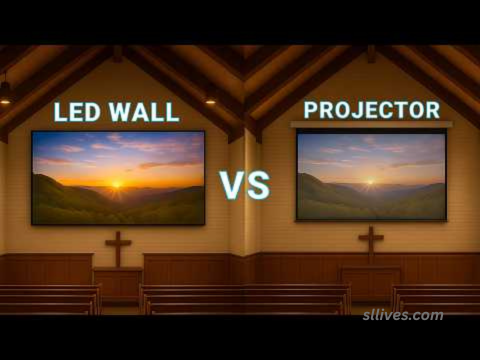
For a working band, the display question is rarely abstract. There is a van, a short soundcheck, a tight budget, and a stage that may change every weekend. A projector can be good enough in one room and nearly invisible in another. An LED wall can look stronger, but it brings different logistics.
The best choice depends on the venues, content, crew, and how often the band needs to carry the system itself.
Projectors Still Have a Place
Projection can be affordable, light to transport, and quick when the venue already has a screen or a clean rear-projection path. It works best in darker rooms with controlled lighting. For simple background visuals, lyric content, or occasional shows, a projector may be the practical choice.
The problem is control. Stage lights, haze, low ceilings, short throw distance, and people walking through the beam can hurt the image. A projector also needs a surface. If the venue does not provide one, the band has to bring and position it.
LED Brings Brightness and Modularity
An LED wall is more visible under stage lighting because it emits light directly. It can be built as a backdrop, split into columns, or used in smaller scenic blocks. It also avoids shadows from performers crossing a projector beam.
AVIXA display guidance often starts with viewing conditions and content legibility. For a band stage, that means asking whether fans will actually see the visuals once the lighting rig turns on. If the room is bright or the screen is central to the show, LED gains an advantage.
Bands and production partners can view product options when comparing rental-style LED panels for stage use, especially when the goal is repeatable setup rather than a one-off installation.
Think About the Crew
A band with no video tech should be careful about owning a system that needs mapping, processing, repairs, and safe rigging. Hiring LED for bigger shows can be smarter than buying too early. A band with a dedicated production crew may get more value from a modular system that can grow with the tour.
Content expectations should be realistic too. Projection can handle simple loops and atmospheric footage. LED can make those visuals brighter, but it also exposes weak design. Low-resolution artwork, tiny text, and files built for a laptop screen may look worse when scaled across a stage wall.
Storage and maintenance should not be ignored. A projector fits in a case. An LED wall needs panels, cases, cables, processors, spare parts, and a place to inspect damaged gear after shows. For many bands, renting first is the cleanest way to learn what the show actually needs.
Venue relationships matter as well. Some rooms already have projection, power, and rigging rules that make a simple setup easy. Others have no useful screen position at all. A band that plays many rooms should track what worked at each venue before committing to a permanent display plan.
The decision is not LED good, projector bad. It is about control. If the band can control light, surface, and setup time, projection may work. If the visuals are part of the ticketed experience and need to survive different rooms, LED starts to make more sense.