
 By sl lives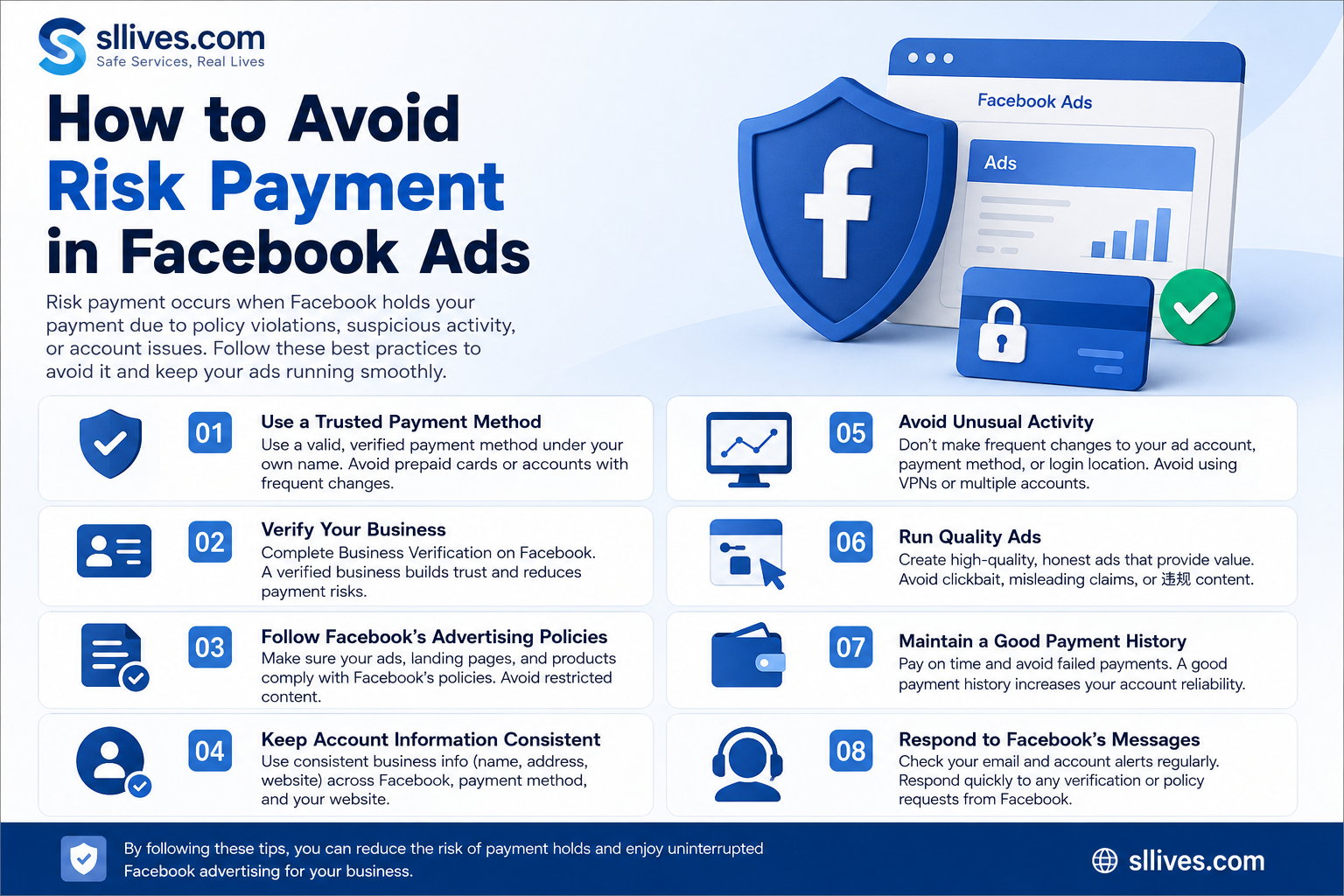
Risk Payment remains one of the most frustrating issues for publishers working with Facebook Ads. More often than not, the situation plays out the same way: the ad account is running smoothly, the campaign is performing well, but suddenly a request for additional payment verification or billing restrictions appears.
The most frustrating thing is that the problem can arise even on accounts that previously operated without issue.
In 2026, Facebook is paying even more attention to payment history, account behaviour and the advertiser’s overall trust score.
Why does ‘Risk Payment’ appear?
Most often, there is more than one reason. The system evaluates dozens of factors simultaneously: sudden changes in spending, suspicious activity, payment issues, unusual account behaviour, and the history of the advertising account.
Restrictions are particularly common following a sudden scaling-up. When an account has been operating at low volumes for a long time and then the budget increases several-fold within a short period, the algorithms may deem such activity suspicious.
Incidentally, the reasons for account suspensions and the factors that most frequently raise concerns with advertising platforms have already been analysed in detail by experts at the AffCommunity media event via the link.
What helps reduce the risk
The main rule is consistency. The more natural the account’s growth appears, the less likely you are to face additional checks.
You shouldn’t suddenly increase budgets, constantly change payment methods, or create chaotic activity within your account dashboard.
It’s also important to keep an eye on the technical side of things. Infrastructure issues, unstable settings, or suspicious actions often serve as an additional red flag for the system.
Approaches to organising the technical side and managing accounts have already been discussed separately in this article.
Can Risk Payment be completely avoided?
There are no guarantees. Even well-prepared accounts sometimes fall under additional checks.
However, experience shows that careful work, gradual scaling, and a clear payment history significantly reduce the likelihood of such restrictions.
Conclusion
Risk Payment is not a coincidence, but part of Facebook’s security system. Most often, the problem arises where algorithms detect increased risk or atypical behaviour.
Therefore, in 2026, it is not those who try to cheat the system who will succeed, but those who build their operations to be as stable and predictable as possible.